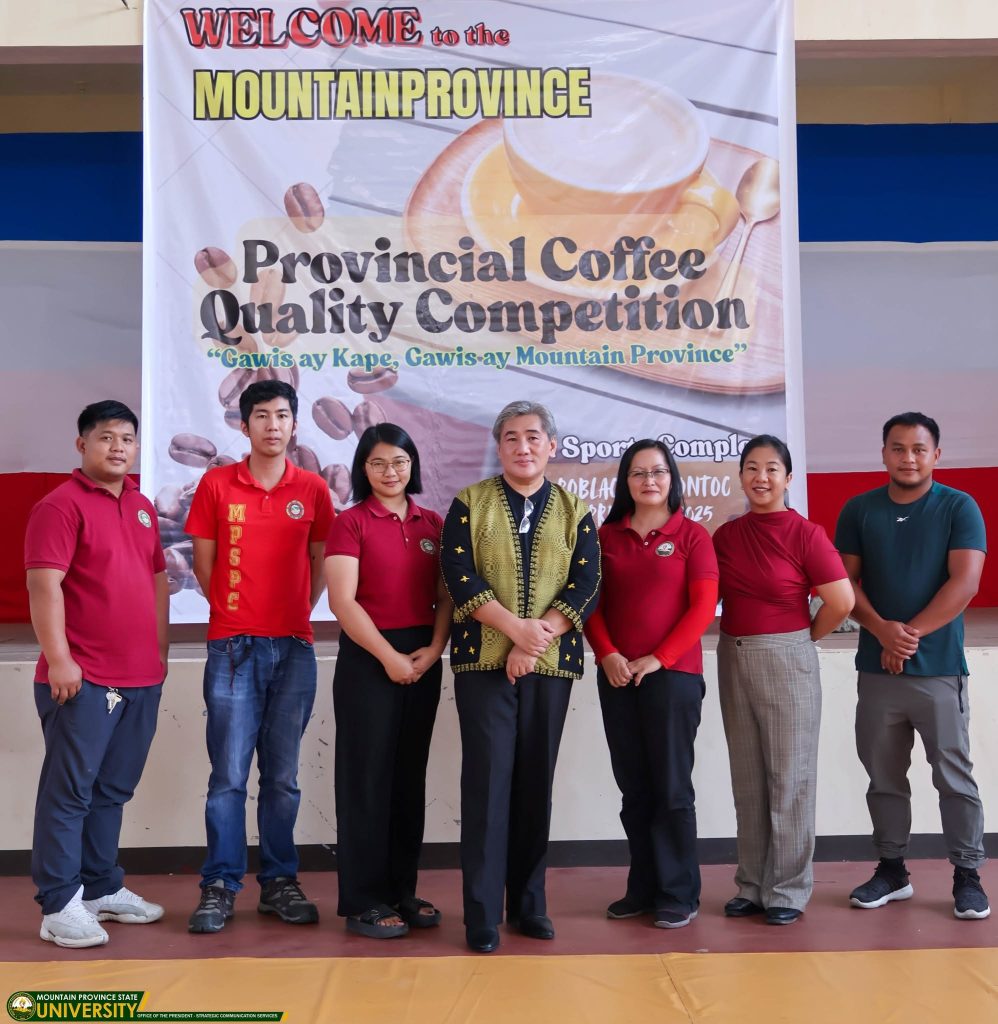
For Mountain Province’s coffee growers, maintaining a productive farm means caring for the soil, managing available water, and responding to weather conditions that influence flowering, fruit development, and harvest quality. These concerns brought practical relevance to the climate-adaptation discussion led by Mountain Province State University (MPSU) President Dr. Edgar G. Cue during the Provincial Coffee Quality Competition at the Leonard G. Mayaen Sports Complex on April 3, 2025.
In his talk, “Adapting to Changing Climate: Ensuring Resilience in Coffee Agriculture,” Dr. Cue shared farming practices that can help growers sustain coffee production amid changing growing conditions. Alongside the cupping of competition entries, the discussion connected coffee quality with the health and resilience of the farms where the beans are grown.
Topics included the effects of prolonged dry periods on soil moisture and coffee-tree growth, as well as the challenges that heavy or untimely rainfall can pose to flowering, disease management, harvesting, and drying. Practical responses included maintaining appropriate shade, mulching to conserve moisture, protecting sloping farmland from erosion, and regularly monitoring trees for pests and diseases. The discussion also emphasized adjusting farm activities to local conditions and preparing protected drying areas for unexpected rainfall.
These concerns are closely related to MPSU’s research and extension work through the Montañosa Coffee Center at the Victor S. Dominguez Research, Extension and Development Center in Ba-ang, Bauko. Its work on coffee nursery management, soil properties, and coffee variety trials provides opportunities to develop locally relevant knowledge for sustainable highland production. These activities can help inform decisions about planting materials and farm management, while further evaluation is needed to establish how particular varieties perform under different climatic conditions.
The University’s own experience with seasonal water shortages at the center also underscores the importance of water security in agricultural production. Its March 2025 discussions with the National Irrigation Administration–Bontoc and Barangay Banao on a proposed solar pump irrigation project reflect efforts to explore a more reliable water supply for the campus and nearby areas.
By bringing climate-adaptation learning into a provincial coffee gathering, MPSU linked its academic expertise and agricultural work with concerns familiar to local growers. The exchange highlighted the value of combining farmers’ experience and local knowledge with research-based guidance suited to Mountain Province’s highland conditions.
Held from April 2 to 4 as part of the 18th Lang-ay Festival and the 58th Mountain Province Founding Anniversary, the competition aimed to strengthen coffee farming and production in the province. MPSU’s participation contributed an educational dimension that connected the pursuit of quality coffee with sustaining farms, conserving resources, and protecting livelihoods.